
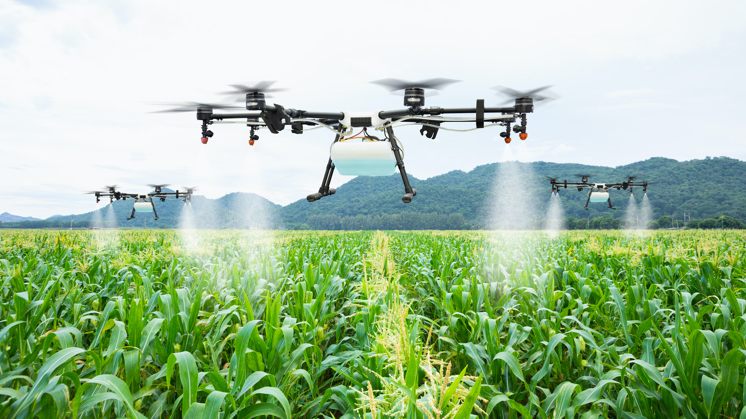
Our chapter Bridging or Widening the Gap? The Dual Impact of Smart Farming Technologies in Achieving Sustainable Development Goals in Europe and Iraq (in the The Oxford Handbook of Power, Politics, and Poverty) examines how smart farming technologies are being promoted as solutions to sustainability, food security, and rural development across very different geopolitical contexts. Focusing on Europe and Iraq, the chapter explores how technologies such as IoT systems, wireless sensor networks, and AI-driven agriculture interact with Sustainable Development Goals related to water, energy, infrastructure, and climate resilience.
At first glance, the chapter appears to sit within a familiar sustainability framework: technological innovation as a pathway toward more efficient, environmentally responsible, and productive agricultural systems. Much like our earlier work on smart cities and surveillance, the analysis initially focused on systematically evaluating technological impacts through SDG-oriented metrics and comparative methodology.
Yet while writing the chapter, we increasingly encountered a deeper tension that extended beyond agriculture itself.
The more we examined the unequal implementation of smart farming technologies between Europe and Iraq, the more difficult it became to treat technology as politically neutral. The central question gradually shifted from whether smart farming “works” to whom it works for, under what conditions, and within which global power structures. In both cases (smart cities and smart farming), sustainability discourse tends to present digital technologies as universally beneficial tools whose primary challenge lies in optimization or implementation. Whether discussing AI-driven surveillance infrastructures in urban governance or precision agriculture in rural development, the underlying assumption often remains the same: technological modernization is treated as inherently progressive.
However, technological systems are never introduced into empty space.
In Europe, smart farming technologies are embedded within advanced infrastructures, public subsidies, research networks, and relatively stable institutional frameworks. Large agribusinesses are able to absorb the costs of AI systems, sensor networks, automated irrigation, and data-driven optimization. As the chapter argues, even within Europe this process already produces uneven outcomes, disproportionately benefiting larger agricultural actors while marginalizing smaller farms.
In Iraq, the situation is fundamentally different. Agricultural modernization unfolds within conditions shaped by infrastructural fragility, political instability, water scarcity, uneven state capacity, and dependence on external technologies. Under such conditions, the demand to “modernize” agriculture risks becoming less a pathway to sustainability and more a mechanism of dependency.
This is where the chapter increasingly moved beyond a purely technical analysis and toward political economy.
A recurring issue throughout the research was the implicit universalism embedded within many SDG implementation frameworks. International sustainability discourse often assumes that technologies validated within highly industrialized environments can simply be transferred into radically different sociopolitical contexts. Yet the empirical literature revealed major asymmetries in infrastructure, technical support, financing capacity, and local adaptability between Europe and Iraq.
What emerges is not merely a technological gap, but a structural one.
In retrospect, this concern links the smart farming chapter very closely to our earlier reflections on smart cities. In both cases, digital technologies risk becoming instruments through which existing inequalities are reorganized and intensified under the language of sustainability. Smart surveillance systems and smart agricultural systems may appear to address different domains, yet both are embedded within broader global infrastructures of capital, expertise, and governance.
The same question appears repeatedly: who owns the infrastructure, who controls the data, who defines efficiency, and who benefits from optimization?
The chapter’s later engagement with Max Ajl and Ismail Sabri Abdallah became especially important for us in this regard. Their work pushes against the assumption that technological modernization alone constitutes development. Instead, technology becomes meaningful only when embedded within sovereign planning, redistributive policy, and socially grounded development strategies.
Without such grounding, “smart” systems may deepen rather than reduce inequality.
This is perhaps the broader thread connecting both our smart city and smart farming research. Increasingly, we find ourselves less interested in whether technologies are smart, sustainable, or innovative in abstract terms, and more interested in the ideological frameworks within which intelligence itself is being organized.
A city optimized for surveillance and a farm optimized for algorithmic efficiency may both be technologically sophisticated while simultaneously reproducing exclusion, dependency, and unequal power relations.
This does not mean technological innovation should be rejected. Rather, it suggests that sustainability cannot be reduced to technical efficiency alone. Questions of ownership, redistribution, sovereignty, labor, and democratic participation remain central, even, and perhaps especially, in highly digitized futures.
As AI-driven governance expands across urban planning, agriculture, healthcare, and climate management, the challenge ahead may not simply be building smarter systems. It may be determining whether those systems are capable of supporting more equitable social relations, or whether they merely automate existing inequalities under a greener vocabulary.

