
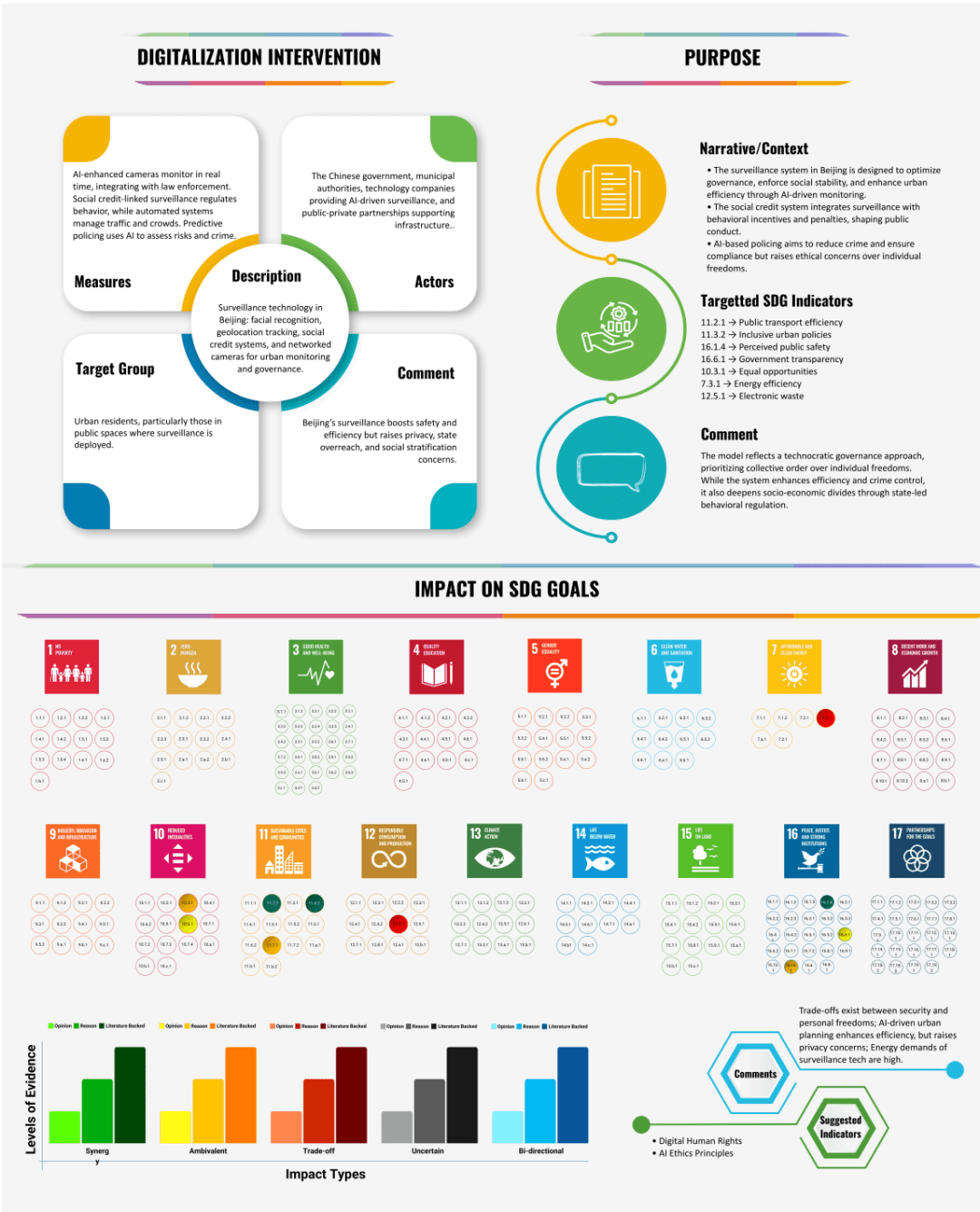
Our chapter Urban Futures: Balancing Sustainability and Privacy in the Smart City Paradigm examines how surveillance technologies are integrated into smart city governance across three urban contexts: Beijing, New York City, and Rio de Janeiro. Using the Digitainability Assessment Framework (DAF), we assess how these technologies interact with selected Sustainable Development Goals (SDGs), particularly those related to inequality, sustainable cities, justice, and institutional accountability.
The chapter’s central argument is that surveillance technologies cannot be evaluated only as technical instruments. Their social effects depend heavily on the ideological and political-economic contexts in which they are deployed. In Beijing, surveillance is framed through state-led urban governance and collective welfare. In New York City, it is entangled with market-oriented security, data commodification, and predictive policing. In Rio de Janeiro, it operates within conditions of deep spatial and social inequality, often reinforcing existing forms of exclusion.
Within the limits of an edited volume chapter, we focused primarily on methodology: applying the DAF systematically, mapping trade-offs and synergies, and comparing how different governance models shape the relationship between surveillance and sustainability. This methodological emphasis was necessary, particularly given the chapter’s comparative scope and word count limitations. At the same time, it inevitably left less room for a broader theoretical question that has since become increasingly central to our work: what kinds of urban futures are made imaginable, or impossible, by the smart city paradigm itself?
The more we continue our research on socialist AI, digital governance, and the political economy of emerging technologies, the more we feel that the “smart city” deserves deeper ideological scrutiny. Increasingly, we are no longer convinced that the central question is simply how to balance innovation, sustainability, and privacy. That framing, while institutionally legible and common within policy discourse, may itself obscure more fundamental issues concerning power, ownership, governance, and the political ontology of technology.
The dominant smart city paradigm frequently presents technological expansion as inherently progressive. Efficiency becomes synonymous with sustainability, optimization becomes synonymous with good governance, and large-scale data extraction becomes normalized as the unavoidable price of urban convenience. Yet many of these systems emerge from deeply neoliberal assumptions about competition, securitization, privatization, and predictive control. Surveillance infrastructures are therefore not politically neutral tools later “applied” to cities. They are material expressions of particular ideological models of society.
This became especially visible to us while comparing the three cities examined in the chapter.
In New York City, surveillance systems appear tightly connected to data commodification, predictive policing, and the protection of economic infrastructures. Urban intelligence becomes inseparable from market logic. In Rio de Janeiro, surveillance frequently operates within fragmented governance structures and conditions of entrenched inequality, producing uneven forms of urban visibility in which marginalized communities become hyper-visible to the state while remaining excluded from many of the benefits associated with smart urbanism.
Beijing complicated the picture further. Much Western scholarship approaches Chinese surveillance primarily through the lens of authoritarianism, often presuming that intensified digital governance necessarily produces social illegitimacy. Yet public perceptions, governance rationales, and cultural understandings of collective welfare do not always fit neatly within liberal assumptions about privacy and state legitimacy. This does not mean surveillance should be romanticized or uncritically defended. However, it does suggest that many critiques of Chinese smart urbanism remain implicitly anchored in Western liberal frameworks, even when presented as universal ethical concerns.
This realization gradually pushed us toward a broader question that exceeded the scope of the original chapter: what would a genuinely post-capitalist or socialist urban digitality look like?
Not merely a smarter city, but a differently organized one.
Current smart city discourse often assumes that the goal of urban technology is optimization: smoother traffic flows, predictive security, automated governance, efficient consumption. Yet optimization for whom? Efficiency in service of what social project? Under capitalism, technological efficiency frequently becomes efficiency of extraction, efficiency of labor control, efficiency of policing, and efficiency of consumption management.
A socialist urban framework would potentially begin elsewhere. Rather than treating citizens primarily as data-generating units to be monitored, predicted, and behaviorally managed, digital infrastructures could instead be oriented toward collective provisioning, participatory planning, public ownership of data infrastructures, and democratic coordination of urban resources. The central issue would no longer simply be whether surveillance is “balanced” by privacy protections, but whether urban intelligence itself serves social welfare rather than accumulation.
In retrospect, we now see Urban Futures as part of a transition within our own thinking. The chapter still operated partially within the institutional language of sustainability governance and SDG-compatible technological assessment. Since then, our research has increasingly moved toward questions of political economy, ideological critique, and the genealogy of socialist approaches to computation and AI. This does not invalidate the earlier work. On the contrary, the methodological discipline required by the chapter helped clarify the limitations of existing evaluative frameworks. Sometimes intellectual development happens precisely through encountering the boundaries of what a framework can comfortably accommodate. Today, as governments and corporations accelerate investments in AI-driven urban infrastructures, these questions feel increasingly urgent. Smart cities are no longer speculative futures. They are emerging governance models shaping everyday life, often with surprisingly little democratic debate concerning the ideological assumptions embedded within them.
Perhaps the challenge ahead is not simply building smarter cities, but imagining cities organized around fundamentally different political and technological values.


One thought on “From smart to socialist cities: rethinking surveillance, sustainability, and urban futures”